



BNMT advocates for TB prevention and patient centered approaches at the World Conference on Lung Health 2025
In November 2025, BNMT Nepal participated in the World Union Conference on Lung Health 2025 held in Copenhagen, Denmark, the world’s largest global gathering focused on lung health. The conference brought together a wide range of global TB experts, academics, service providers, innovators, multilateral partners, and research and development organizations. Participants shared best practices, showcased innovations, and advocated for strengthened solutions to improve TB diagnosis, treatment, and prevention.
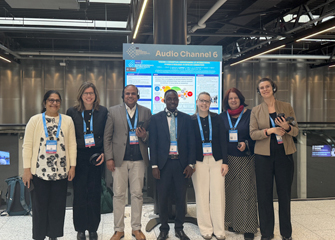
BNMT Nepal was proud to take part in this event with four presentations (two oral and two posters) and two exhibitions at the COMMUNITY CONNECT session. Representatives from BNMT Nepal were: Executive Director Raghu Dhital, Senior TB Scientist Dr Maxine Caws and our Health Economist, Anchal Thapa.
Colleague Anchal Thapa did two oral presentations in the conference:
‘Impact & cost-effectiveness of implementing TB preventive treatment among adult household contact persons in Nepal: A model-based analysis’: Drawing on evidence from the IMPACT 2 TB project, Anchal demonstrated that 3HP regimen is highly cost effective & should be scaled up nationwide to accelerate progress towards END TB goals. Her findings emphasized the importance of decentralized, locally adapted and cost efficient delivery strategies to maximize the public health impact.
‘DronEconomics: The cost of implementing drones to facilitate TB sputum sample collection in hard-to-reach areas in Nepal’: Funded by the Royal Society of Tropical Medicine and Hygiene’s Early Career Research Grant, this study showed that drone transport in Pyuthan reduced sample transport time from 2.3 hours on foot to just 6 minutes. Although initial costs were high due to infrastructure and setup, expenses significantly decreased with higher flight frequency and reliance on local resources. The findings highlight the need for long-term funding to ensure uninterrupted drone operations and optimal resource allocation.
Similarly, colleague, Raghu Dhital presented a poster titled, ‘Healthcare providers’ perception of tuberculosis-related stigma: Drivers and manifestations within Nepal’s cultural context’. Conducted under the CHANGE TB project funded by the Stop TB Partnership CFCS grant, this study revealed that TB related stigma disrupts timely diagnosis and care. Healthcare providers reported that limited knowledge, fear of infection, and risk of being identified discourage people from seeking testing and treatment. Women, people living in poverty and ethnic minorities, face greater TB-related stigma. Women particularly are sent away to paternal homes, isolated in cow sheds, and face marriage difficulties leading to interruptions in complete diagnosis and care. The study underscores the need for people-centered approaches such as counselling, confidentiality, peer and family support, and gender-sensitive TB care as key to overcome stigma and improve TB outcomes.
Also, colleague Dr Maxine Caws presented a poster titled, ‘The landscape of TB stigma in Nepal: Contextual evidence of stigma levels, manifestations, and experiences among people with TB’. Based on findings from the CHANGE TB project, the study showed that TB-related stigma is highly prevalent for people with TB in Nepal. 69% reported stigma; often hiding their condition and distancing themselves from others, leading to guilt and emotional distress. Stigma results in isolation, abandonment, disruption of education and employment. Women and those from rural, low-income communities are disproportionately affected. Integrating person-centered care is crucial to reduce TB-stigma. Psychosocial counselling, peer support, TB clubs, family-centered counseling & community education is essential to promote equitable care, particularly for women & marginalized populations.
BNMT Nepal was honored to be featured in the COMMUNITY CONNECT session, a dynamic platform showcasing global art and photography under the theme “Stigma and Voices of Vulnerable Populations.” Two of BNMT’s works were selected:
- Artwork: “A Wall That Speaks” — a TB awareness mural addressing stigma, funded under the CHANGE TB project by the Stop TB Partnership.
- Photography: “Towards a Safer Tomorrow” — featuring 11-year-old Gaurav Gautam beginning 3HP preventive therapy for latent TB, funded under the CRITIC project by The Union.
The conference also provided an important moment to reaffirm BNMT Nepal’s eight-year partnership with the Liverpool School of Tropical Medicine (LSTM). Executive Director Raghu Dhital and Prof. Bertie Squire from LSTM signed an MOU to continue and strengthen this long-standing collaboration.
Overall, the World Conference on Lung Health 2025 proved to be an outstanding platform for BNMT Nepal to share research, build partnerships, expand networks, and further our advocacy and scientific efforts toward ending TB.


News & Events
 International Conference on Health Economics 2025
 BNMT advocates for TB prevention and patient centered approaches at the World Conference on Lung Health 2025
Stories

From Learning to Leading: Alina’s Impactful Journey with BNMT Project HORIZON
My name is Alina Adhikari, and I live in Sindhupalchowk District. I am currently in my final year of my master’s studies. I worked as a community health supervisor for the Horizon project at BNMT from 1st Feb, 2022 -...